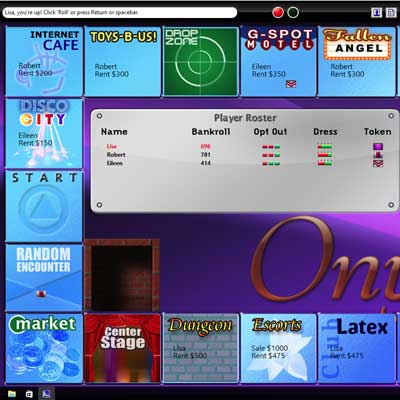
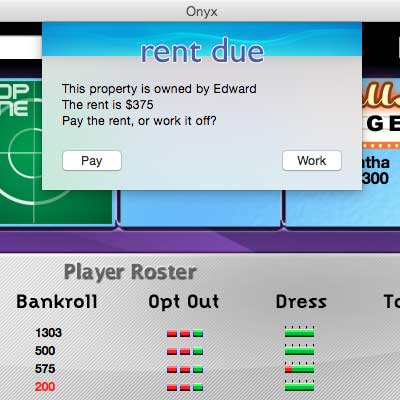
Onyx is a computer sex game. Move around the board buying up properties. If you land on a property that is owned by somebody else, you must either pay rent or work off the debt! Players work off debt with all kinds of intimate actions, from mild to kinky. As the game progresses, so does the action! Play with people you are intimate with, or want to be!
You can work off the debt by being assigned fun, sexy erotic actions.
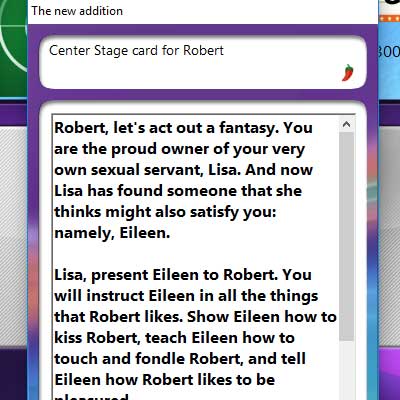
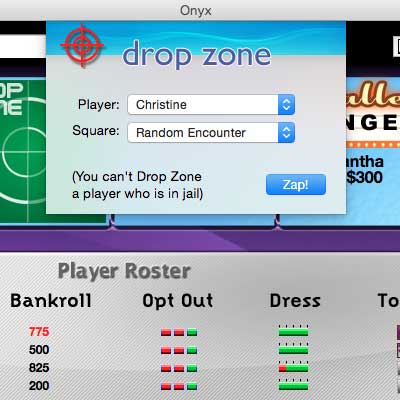
Look out for special squares! If you land on the Torture Chamber, you must draw a "torture card" with an erotic torture on it. At Center Stage, you are put on display; in the Random Encounter square, you will be assigned an erotic action with another player; and on the Fate squares, the luck of the draw dictates your fate.
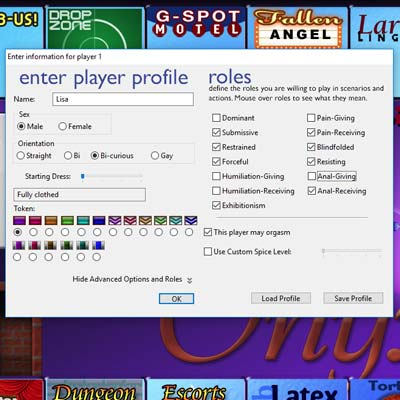
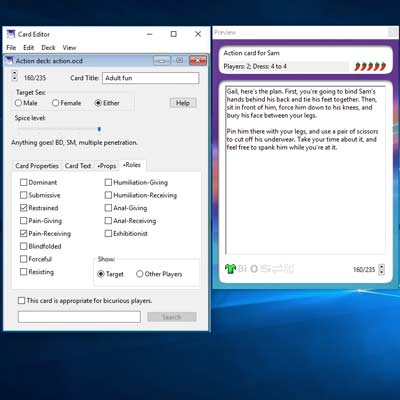
You control the "spice" of the erotic actions, from harmless fun to wild, anything-goes kink. You choose "roles," which tell the game what kinds of actions you prefer to be involved in. If you don't like being tied up, just tell Onyx that you will not accept the "bondage" role.
Onyx 3.6 and earlier did not work on Macs requiring 64-bit native apps. Onyx 3.7 now works on modern Macs, and is optimized to run natively on Apple Silicon Macs. A version of Onyx that runs natively on Windows ARM devices is also available!
UPDATE: Some Mac users were reporting an error saying “Onyx 3.7.app can’t be opened because Apple cannot check it for malicious software.” I have updated the app to address this issue; it should work properly now.
Onyx runs on Macs (OS X 10.14 or later), Windows (Windows 7 or later), Windows for ARM (Windows 11 or later), and x86 Linux (GTK 2.0+).
Onyx is available for free download. The free version can only be played on the mildest two "spice level" settings. Onyx can be registered by paying the $35 shareware fee. Registration gives you a serial number to unlock the full version, and it also gives you the Card Editor program, which you can use to create your own card decks.
Onyx contains explicit descriptions of sexual acts. Some of the high-level actions in Onyx describe erotic actions like bondage and power exchange.
IF YOU ARE OFFENDED BY SEXUAL ACTIONS, BEHAVIOR, OR DESCRIPTIONS, DON'T DOWNLOAD THIS SOFTWARE!
If you are under the legal age of consent or live in a place where this material may be restricted or illegal, YOU SPECIFICALLY DO NOT HAVE A LICENSE TO OWN OR USE THIS COMPUTER PROGRAM. There is absolutely no warranty of any kind, expressed or implied. Use it at your own risk; the author disclaims all responsibility for any kind of damage to your computer, your car, your refrigerator, or to anything else.
By downloading Onyx, you certify that you are an adult, age 18 or over, and that you consent to see materials of a sexual nature.
By supporting and celebrating the transgender community and LGBTQ culture, we can help create a more just and equitable society for all. This requires a commitment to understanding, empathy, and action, as well as a willingness to listen to and amplify the voices of marginalized individuals.
The transgender community and LGBTQ culture are rich and diverse, encompassing a wide range of experiences, identities, and expressions. At its core, LGBTQ culture is about the celebration of diversity, the pursuit of equality, and the unwavering commitment to the well-being and happiness of all individuals, regardless of their sexual orientation or gender identity.
The transgender community is a vital part of the broader LGBTQ+ spectrum. Transgender individuals, often referred to as trans people, are those whose gender identity differs from the sex they were assigned at birth. This community includes people who identify as male, female, non-binary, genderqueer, or any other identity that aligns with their personal experience of gender.
In the context of the LGBTQ community, intersectionality is crucial for understanding the experiences of transgender people of color, LGBTQ individuals with disabilities, and other marginalized groups within the community. By acknowledging and addressing these intersections, we can work towards a more inclusive and equitable society for all.
The LGBTQ community is not monolithic; it is diverse and intersectional. LGBTQ individuals come from various racial, ethnic, socioeconomic, and religious backgrounds, each with their own unique experiences and challenges. Intersectionality, a concept coined by Kimberlé Crenshaw, highlights the importance of considering how different forms of oppression intersect and impact individuals in complex ways.
By supporting and celebrating the transgender community and LGBTQ culture, we can help create a more just and equitable society for all. This requires a commitment to understanding, empathy, and action, as well as a willingness to listen to and amplify the voices of marginalized individuals.
The transgender community and LGBTQ culture are rich and diverse, encompassing a wide range of experiences, identities, and expressions. At its core, LGBTQ culture is about the celebration of diversity, the pursuit of equality, and the unwavering commitment to the well-being and happiness of all individuals, regardless of their sexual orientation or gender identity. solo shemales jerking link
The transgender community is a vital part of the broader LGBTQ+ spectrum. Transgender individuals, often referred to as trans people, are those whose gender identity differs from the sex they were assigned at birth. This community includes people who identify as male, female, non-binary, genderqueer, or any other identity that aligns with their personal experience of gender. By supporting and celebrating the transgender community and
In the context of the LGBTQ community, intersectionality is crucial for understanding the experiences of transgender people of color, LGBTQ individuals with disabilities, and other marginalized groups within the community. By acknowledging and addressing these intersections, we can work towards a more inclusive and equitable society for all. At its core, LGBTQ culture is about the
The LGBTQ community is not monolithic; it is diverse and intersectional. LGBTQ individuals come from various racial, ethnic, socioeconomic, and religious backgrounds, each with their own unique experiences and challenges. Intersectionality, a concept coined by Kimberlé Crenshaw, highlights the importance of considering how different forms of oppression intersect and impact individuals in complex ways.