3D-QSAR
Simplify Drug Design

wlx893u3 manual full

Wlx893u3 Manual — Full

In a cluttered repair shop at the edge of a sleepy port town, a battered cardboard box sat like a relic. Stenciled across its side in a faded black font was a string of characters that meant nothing to most: WLX893U3. For Mara, who ran the shop from dawn until the sea mist climbed the windows, that code felt like a promise — of mystery, of a job that might finally pull her out of slow days and loose screws.

At the last stop, on a shoal of rocks just beyond where the waves whisper secrets, they found the other device — a cousin to the WLX893U3 but scarred by sleep and neglect. The manual instructed them to place both machines facing one another, to let oceans of small, human acts bridge the gap between them. Mara whispered the repair shop’s best stories into the first; Lin fed the second with memories of a childhood island. The machines sang — a low mechanical chorus that rose like fog. Light stitched between them, and memories, once drifting like flotsam, returned to their owners: a song remembered by a fisherman, a name regained by an old friend, a photograph no longer blank.

Curiosity is a tool as sharp as any spanner. Mara set aside the orders she’d been delaying and followed the manual’s first instruction: clean the casing with water that had seen sunlight. She opened the WLX893U3, a machine that looked like an old radio had married a clock and produced something oddly human. Inside, parts slumbered under dust like years folded into a suitcase. She wiped, hummed, and for the first time since she could remember, the shop felt like a stage. wlx893u3 manual full

Then, months later, the sea tossed a stranger into town — a woman who called herself Lin and who claimed the WLX893U3 was part of a quartet, each machine bound to a different harbor and each manual a fragment of a longer story. Her words threaded with salt and urgency: somewhere, an entire device lay dormant, its manual half-burned, and if not restored it would unwrite a small string of memories across the world. The WLX893U3 in Mara’s shop thrummed as if in alarm. The manual’s final pages, previously ordinary schematics, rearranged themselves into coordinates and a poem about tide patterns.

Years later, long after the machines had become part of local legend, a child asked Mara what the WLX893U3 really was. She smiled and, without unfolding the manual’s secrets, answered: “It’s a machine that remembers how to be kind.” The child frowned. “Manuals are for parts,” he said. “This one... it’s for people.” In a cluttered repair shop at the edge

But the manual had cautions too. Some pages were eaten by a pattern of stippled ink that resembled tears. One passage warned: “Do not feed the machine regret untempered by mercy.” A man came in late one winter night carrying a letter he’d never sent. He wanted the WLX893U3 to reverse the moment he had chosen silence. The manual’s script tightened: only the living may be mended; time is not a stitch to be undone. Mara refused. She could not offer a false promise; the manual, for all its softness, had rules.

The first page began not with specifications, but with a single line: “To breathe life into what was never meant to be lifeless, read patiently.” Beneath it, diagrams unspooled like maps — not of parts, exactly, but of gestures: a finger pressed here, a breath there, a pause between gears measured in heartbeats. Where other manuals spoke of torque and tolerance, this one catalogued moods: “When the core is hungry, sing a low note of gratitude.” Annotations in the margins used a shorthand that mixed electrical symbols with tiny botanical sketches — a sunflower beside a circuit, a wave beside a resistor. At the last stop, on a shoal of

Word spread, the way things do in small towns: quietly, then in clusters. People came not with devices to be fixed so much as with old losses and soft questions. A retired watchmaker brought a pocket watch that had stopped the day his father left; the manual instructed Mara to align its hands with the rhythm of the watchmaker’s childhood whistling. A schoolteacher arrived with an orchestra of broken metronomes; the manual told her to set each to the tempo of a school day’s laughter. Each repair read like reconciliation, and each reconciliation made the WLX893U3 pulse brighter.


wlx893u3 manual full

In a cluttered repair shop at the edge of a sleepy port town, a battered cardboard box sat like a relic. Stenciled across its side in a faded black font was a string of characters that meant nothing to most: WLX893U3. For Mara, who ran the shop from dawn until the sea mist climbed the windows, that code felt like a promise — of mystery, of a job that might finally pull her out of slow days and loose screws.

At the last stop, on a shoal of rocks just beyond where the waves whisper secrets, they found the other device — a cousin to the WLX893U3 but scarred by sleep and neglect. The manual instructed them to place both machines facing one another, to let oceans of small, human acts bridge the gap between them. Mara whispered the repair shop’s best stories into the first; Lin fed the second with memories of a childhood island. The machines sang — a low mechanical chorus that rose like fog. Light stitched between them, and memories, once drifting like flotsam, returned to their owners: a song remembered by a fisherman, a name regained by an old friend, a photograph no longer blank.

Curiosity is a tool as sharp as any spanner. Mara set aside the orders she’d been delaying and followed the manual’s first instruction: clean the casing with water that had seen sunlight. She opened the WLX893U3, a machine that looked like an old radio had married a clock and produced something oddly human. Inside, parts slumbered under dust like years folded into a suitcase. She wiped, hummed, and for the first time since she could remember, the shop felt like a stage.

Then, months later, the sea tossed a stranger into town — a woman who called herself Lin and who claimed the WLX893U3 was part of a quartet, each machine bound to a different harbor and each manual a fragment of a longer story. Her words threaded with salt and urgency: somewhere, an entire device lay dormant, its manual half-burned, and if not restored it would unwrite a small string of memories across the world. The WLX893U3 in Mara’s shop thrummed as if in alarm. The manual’s final pages, previously ordinary schematics, rearranged themselves into coordinates and a poem about tide patterns.

Years later, long after the machines had become part of local legend, a child asked Mara what the WLX893U3 really was. She smiled and, without unfolding the manual’s secrets, answered: “It’s a machine that remembers how to be kind.” The child frowned. “Manuals are for parts,” he said. “This one... it’s for people.”

But the manual had cautions too. Some pages were eaten by a pattern of stippled ink that resembled tears. One passage warned: “Do not feed the machine regret untempered by mercy.” A man came in late one winter night carrying a letter he’d never sent. He wanted the WLX893U3 to reverse the moment he had chosen silence. The manual’s script tightened: only the living may be mended; time is not a stitch to be undone. Mara refused. She could not offer a false promise; the manual, for all its softness, had rules.

The first page began not with specifications, but with a single line: “To breathe life into what was never meant to be lifeless, read patiently.” Beneath it, diagrams unspooled like maps — not of parts, exactly, but of gestures: a finger pressed here, a breath there, a pause between gears measured in heartbeats. Where other manuals spoke of torque and tolerance, this one catalogued moods: “When the core is hungry, sing a low note of gratitude.” Annotations in the margins used a shorthand that mixed electrical symbols with tiny botanical sketches — a sunflower beside a circuit, a wave beside a resistor.

Word spread, the way things do in small towns: quietly, then in clusters. People came not with devices to be fixed so much as with old losses and soft questions. A retired watchmaker brought a pocket watch that had stopped the day his father left; the manual instructed Mara to align its hands with the rhythm of the watchmaker’s childhood whistling. A schoolteacher arrived with an orchestra of broken metronomes; the manual told her to set each to the tempo of a school day’s laughter. Each repair read like reconciliation, and each reconciliation made the WLX893U3 pulse brighter.

welcome to 3D-QSAR.com

Fast Molecule Management

Welcome to the first web application for Pharmaceutical Chemistry. 3D-QSAR.com offers user friendly and advanced tools for developing either ligand-based or structure-based 3D QSAR models and performing common useful operations over dataset of molecules.

Sign Up Know More
welcome to 3D-QSAR.com

Explore New Technologies

Our research team is always exploring new technologies and offering them as new products for you to use. Graph Neural Networks (GCNs) are a promising new frontier for Chemistry models development and we are working right now to make them part of the tools available to you.

Read More

Applications

Click on any button to start using the platform. If you want to know a bit more about the application, visit the link below to see all you will be able to do.

Explore Apps
In silico local QSAR modeling of bioconcentration factor of organophosphate pesticides Purusottam Banjare, Balaji Matore, Jagadish Singh, Partha Pratim Roy In Silico Pharmacology Evaluation of molecular structure based descriptors for the prediction of pEC50(M) for the selective adenosine A2A Receptor Nilima Rani Das, Sneha Prabha Mishra, P. Ganga RajuAchary Journal of Molecular Structure Alkylated monoterpene indole alkaloid derivatives as potent P-glycoprotein inhibitors in resistant cancer cells David S P Cardoso, Annamária Kincses, Márta Nové, Gabriella Spengler, Silva Mulhovo, João Aires-de-Sousa, Daniel J V A Dos Santos, Maria-José U Ferreira European Journal of Medicinal Chemistry Computational Studies of 3D-QSAR on a Highly Active Series of Naturally Occurring Nonnucleoside Inhibitors of HIV-1 RT (NNRTI) Waqar Hussain, Arshia Majeed, Ammara Akhtar and Nouman Rasool Journal of Computational Biophysics and Chemistry

A Valuable Tool

We are at the beginning of our journey but our work is already being recognized. These are the projects that mention 3D-QSAR.com as a valuable resource for their results and have been empowered with our tools. We thank you greatly.

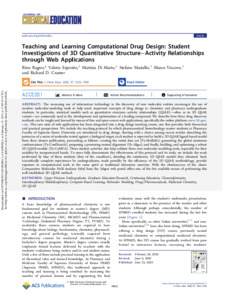
Paper: Teaching and learning computational
                              drug design: Studenti Investigations of 3D
                              Quantitative Structure–Activity Relationship
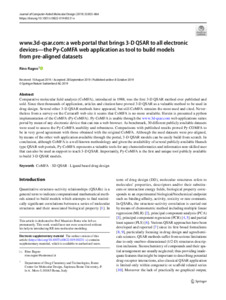
                              through Web Applications. Teaching and Learning Computational Drug Design... Journal of Chemical Education Paper: www.3d-qsar.com a web portal that brings
                              3-D QSAR to all electronic devices. the Py-CoMFA
                              web application as tool to build models from
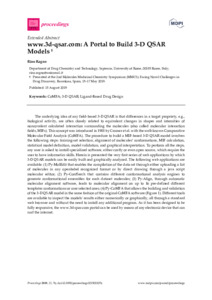
                              pre-aligned datasets. www.3d-qsar.com: a web portal that brings 3-D QSAR to all... Journal of Computer-Aided Molecular Design Paper: a portal to build 3-D QSAR Models. A Portal to Build 3-D QSAR Models. Proceedings

Reference Our Work

3D-QSAR.com is the result of an effort of our research team to offer valuable and easily accessible tools for the development of new active molecules. Cite our work by clicking on the pages or contact us directly.

Contact Us